
Adult ADHD and Neurodivergent Care in Los Angeles: How an Evaluation Works

Updated: 5 days ago
Written by the Prescribed Wellness Psychiatry team · Medically reviewed by Veronica Sanchez, MD · Updated September 2026
Yes. Prescribed Wellness Psychiatry evaluates and treats adult ADHD, and cares for other neurodivergent high functioning adults, in person at our Los Angeles office between Toluca Lake and Burbank, or by secure video anywhere in California. An adult ADHD evaluation is a structured conversation with a psychiatrist, not a single test. Treatment can include medication, therapy, and practical supports built around how your brain actually works.
If you were never evaluated as a child, you are in good company. More than half of U.S. adults with an ADHD diagnosis were diagnosed at 18 or older, according to the CDC. This page explains how an adult evaluation works, how ADHD differs from anxiety, what neurodivergent-informed care means here, and what treatment involves.
Key takeaways✓ About 15.5 million U.S. adults, 6% of the adult population, had a current ADHD diagnosis in 2023, and 55.9% of them were first diagnosed at age 18 or older, according to the CDC. ✓ There is no blood test or brain scan for ADHD. Diagnosis comes from a clinical evaluation: your symptoms now and in childhood, rating scales, input from people who know you, and ruling out conditions that look similar. ✓ ADHD and autism can be diagnosed in the same person. A 2019 meta-analysis in The Lancet Psychiatry found that about 28% of autistic people also have ADHD. ✓ Stimulants and the non-stimulant atomoxetine are the treatments with the strongest evidence for core adult ADHD symptoms, according to a 2025 Lancet Psychiatry analysis of 113 trials. Whether medication is right for you is a decision made with your prescriber. ✓ Under current federal rules, ADHD medication can be prescribed by video without a prior in-person visit through December 31, 2026, according to the DEA but many insurances and pharmacies require at least one in-person visit within the first 6 months or for the initial evaluation. ✓ |
Do you treat adult ADHD in Los Angeles?
Yes. Dr. Veronica Sanchez evaluates and treats adults with ADHD at 3800 Barham Blvd, Suite 416, on the Cahuenga Pass between Toluca Lake, Burbank, Studio City, and Universal City, with parking in the building. She also sees patients by secure video anywhere in California, which matters for ADHD care, where follow-up visits are frequent and a 40-minute drive is one more thing to keep track of. Visits can be in English or Spanish.
Adult ADHD is common and under-treated. The CDC reported in 2024 that 15.5 million U.S. adults had a current ADHD diagnosis in 2023, about one in 16, and that only about a third were taking medication for it. In an earlier national survey published in the American Journal of Psychiatry, just 10% of adults with ADHD had received treatment for it in the previous year, even though many were being treated for anxiety or depression instead.
How is ADHD diagnosed in adults?
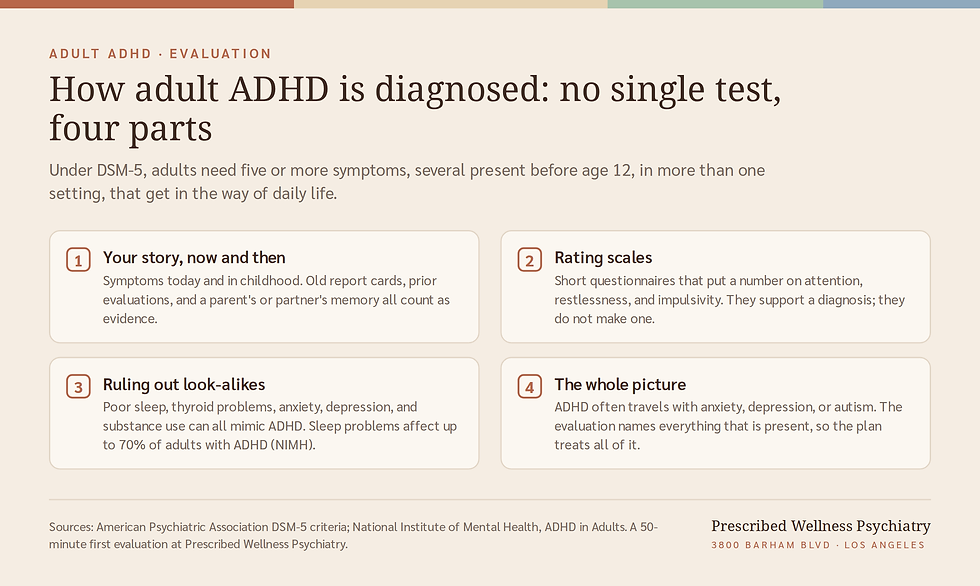
Through a clinical evaluation, not a single test. There is no blood test or brain scan that diagnoses ADHD. Under the American Psychiatric Association's DSM-5 criteria, adults 17 and older need five or more symptoms of inattention or hyperactivity and impulsivity, several of those symptoms must have been present before age 12, and they must show up in more than one setting and get in the way of work, school, or relationships.
In practice, that means Dr. Sanchez asks about your life now and your life as a kid. Report cards, old evaluations, and a parent's or sibling's memory are useful, because ADHD is a developmental condition: the symptoms start in childhood even when nobody named them. The National Institute of Mental Health notes that a clinician may ask to talk with people who know you well, use behavior rating scales and symptom checklists, and sometimes order psychological testing.
The other half of the evaluation is ruling things out. Poor sleep, thyroid problems, depression, anxiety, and substance use can all look like ADHD. NIMH notes that sleep problems affect up to 70% of adults with ADHD, and untangling which came first takes time. That is one reason our first evaluation is 50 minutes rather than fifteen.
If you were a quiet, daydreaming kid rather than a disruptive one, you may have been missed. NIMH notes that ADHD symptoms among girls and women are especially likely to have been overlooked. Many of her patients are highly intelligent and successful, yet life has started to feel harder, with more trouble organizing, planning, or sorting out their thoughts. It doesn't have to stay this way.
Is it ADHD, anxiety, or both?
Often both. More than half of adults with ADHD in a 2022 study in Psychiatry Research had at least one anxiety disorder, and the 2006 national survey found adult ADHD highly co-morbid with anxiety and mood disorders.
They also mimic each other. Anxiety makes it hard to concentrate. ADHD makes missed deadlines and lost keys a constant source of worry. A psychiatrist separates them by timing and pattern. ADHD symptoms are lifelong and present even on calm days. Anxiety-driven inattention usually rises and falls with the worry itself. Restlessness, racing thoughts, and poor sleep show up in both, so we look at the whole picture rather than any one symptom.
What we look at | Points toward ADHD | Points toward anxiety |
When it started | Childhood, even if nobody named it | Childhood, often with common worries |
Focus on a calm day | Still scattered, especially on boring tasks | Usually fine when the worry lifts |
What the mind does | Drifts, jumps, loses the thread | Loops on the same fear or thinks about "worst case" |
Restlessness | Physical, hard to sit through a meeting | Muscle tension, feeling as if something bad is going to happen |
Sleep | Trouble winding down, late bedtimes | Trouble falling asleep because of overwhelming worries |
The distinction matters because the treatments differ, and because treating one without the other tends to leave you half better. When both are present, both get a plan.
What does "neurodivergent" mean, and do you see autistic adults?
Neurodivergent is an umbrella term for brains that work differently from the typical pattern, including ADHD, autism, dyslexia, and related conditions. It is not a diagnosis. It is a way of describing yourself, and many of our patients use it.
Yes, we see high functioning verbal autistic adults. The CDC estimates that 2.21% of U.S. adults are autistic, and it notes there is no surveillance system to find adults who were never identified, which is a polite way of saying many were missed, especially people with strong language skills who learned to mask. ADHD and autism also overlap far more than people expect. The DSM-5 removed the old rule that kept them from being diagnosed together, and a 2019 meta-analysis of 96 studies in The Lancet Psychiatry found that about 28% of autistic people also have ADHD, 20% have an anxiety disorder, and 11% have a depressive disorder. Some people call the combination AuDHD.
Here is what psychiatric care looks like for a neurodivergent adult. Dr. Sanchez treats the conditions that make daily life harder, such as ADHD, anxiety, depression, and sleep. She works with the way your brain is wired rather than against it. She thinks about your comfort before you book your first appointment. Her office avoids bright lights, she averts eye contact if you prefer it and she has tactile sensory items in her office to help you reduce any over-stimulation you might feel meeting someone new. Video visits, written follow-up after the visit, and direct questions are all options. When formal autism testing would help, for example for workplace accommodations, we can refer you to a psychologist for that evaluation and coordinate care.
What are the treatment options for adult ADHD?
The strongest evidence is for medication, and there are two main groups. Stimulants (methylphenidate and amphetamine products) and the non-stimulant atomoxetine were the only treatments shown to reduce core ADHD symptoms in adults on both clinician and patient ratings, in a 2025 Lancet Psychiatry analysis of 113 randomized trials with more than 14,800 participants. Psychological approaches such as cognitive behavioral therapy and mindfulness showed some benefit on clinician ratings but not on patients' own ratings, and most trials lasted only about 12 weeks, so long-term data is needed.
An earlier 2018 Lancet Psychiatry network meta-analysis reached a similar conclusion: in adults, amphetamines had the largest effect, with methylphenidate and atomoxetine producing moderate improvements. Which medication fits you, if any, depends on your history, other conditions, heart health, and what you can tolerate. That is a decision you and your prescriber make together. This post is education, not a recommendation.
Side effects are real and worth naming. Reduced appetite, trouble sleeping, and small increases in blood pressure and heart rate are common with both stimulants and atomoxetine, which is why we check blood pressure and pulse and ask about sleep at follow-ups. This is where in-person visits come in, although they do not have to be every visit. Most patients will come in about once a year. In 2023 the FDA updated the boxed warning on all prescription stimulants to stress the risks of misuse, abuse, and addiction, and to remind patients never to share their medication. We take that seriously: we assess risk before prescribing and monitor over time. Our post on weight changes on psychiatric medication covers appetite effects in more detail.
Medication is rarely the whole plan. Therapy, ADHD coaching, sleep, exercise, and simple external systems (one calendar, one list, alarms that are not optional) do real work, and for some people they are the plan. Our concierge services help you put these pieces in place, so you're not building it all on your own. To learn about these pillars visit our concierge psychiatry membership page.

Can I get ADHD medication by telehealth in California?
Yes, for now. Under a federal rule the DEA extended on December 31, 2025, practitioners may prescribe Schedule II through V controlled medications, which includes stimulants, by audio-video telemedicine without a prior in-person visit through December 31, 2026 but it can be common for your pharmacy or health insurance plan to request you be seen in-person at least once. You must be physically in California during a video visit with a California-licensed psychiatrist. Dr. Sanchez sees ADHD patients both ways, and many alternate: an in-person evaluation, then video follow-ups from home or from a lunch break on the lot.
Shortages are the other reality. In the CDC's 2023 survey, 71.5% of adults taking ADHD medication had trouble getting a prescription filled in the past year because it was unavailable. We cannot control supply, but we can plan for it: talk through alternatives before you run out.
What does ADHD care look like at Prescribed Wellness?
A 50-minute first evaluation, then 25-minute follow-ups. Dr. Sanchez practices psychiatry rooted in integrative wellness, so sleep, movement, nutrition, are part of an ADHD plan from the first visit, not an afterthought. She coordinates with your therapist or coach with your permission, and with your primary care doctor when heart health or labs are part of the picture. You can read more about Dr. Sanchez here.
Many of our patients work in the industry, where call times and hiatus weeks make routine hard, so we build plans that survive a production schedule. Our guide for people who work in entertainment covers scheduling and privacy. We are in network with Aetna, Anthem Blue Cross, Carelon Behavioral Health, Cigna, Optum, UnitedHealthcare and Medicare, and provide superbills for other plans. Self-pay rates are available with a Good Faith Estimate before your first visit.
How do I get started?
Call or text (626) 681-3729 or request an appointment online. Mention that you want an adult ADHD evaluation so we book the full 50 minutes.
Gather what you have: old report cards, any prior evaluation or testing, and a list of medications you take now and have tried before.
Ask a parent, older sibling, or long-time partner what they remember. Their notes count as evidence.
Complete the intake forms sent before your visit. Details are on our current patients page.
Write down your three biggest questions and bring them. Phones die in waiting rooms.
Not sure whether it is ADHD at all? That is a fine reason to come in. The evaluation is designed to answer that question, and our post on what to expect at your first psychiatric evaluation walks through the visit step by step.
Office, insurance and booking details are on our pages for psychiatrists in Los Angeles and psychiatrists serving Burbank.
Frequently asked questions
Can you be diagnosed with ADHD for the first time as an adult?
Yes. According to the CDC, 55.9% of U.S. adults with a current ADHD diagnosis were first diagnosed at age 18 or older. The condition still has to have started in childhood, so an adult evaluation looks back at school years as well as the present. Many adults were simply never evaluated, especially women and quieter, inattentive kids.
Do I need testing to get an adult ADHD diagnosis?
There is no blood test or brain scan for ADHD. Diagnosis comes from a clinical evaluation: a detailed interview about your symptoms now and in childhood, rating scales, and often input from someone who knows you well. Psychological testing is sometimes added when the picture is unclear or when learning differences may also be present.
Can you have ADHD and autism at the same time?
Yes. The DSM-5 removed the old rule that prevented diagnosing both, because the two often occur together. A 2019 meta-analysis in The Lancet Psychiatry found that about 28% of autistic people also have ADHD. Some people use the term AuDHD for the combination. Dr. Sanchez evaluates and treats adults with either or both.
Can a psychiatrist prescribe ADHD medication over video in California?
Yes, under current federal rules. The DEA has extended telemedicine flexibilities that allow prescribing of controlled medications, including stimulants, by audio-video visit without a prior in-person exam through December 31, 2026. In practice, your pharmacy or health plan may still ask you to be seen in person at least once. You must be physically in California during a visit with a California-licensed psychiatrist. We see ADHD patients in person and by video.
How can you tell whether it is ADHD or anxiety?
By timing and pattern. ADHD symptoms begin in childhood and are present even on calm days, while anxiety-driven inattention usually rises and falls with worry. The two often overlap: more than half of adults with ADHD in a 2022 study had at least one anxiety disorder. A psychiatric evaluation sorts out which is present, and when both are, both get treated.
Does insurance cover an adult ADHD evaluation near Burbank?
Most health plans cover a psychiatric evaluation and medication management, though copays and referral rules vary. Prescribed Wellness Psychiatry is in network with Aetna, Anthem Blue Cross, Carelon Behavioral Health, Cigna, Optum, UnitedHealthcare and Medicare, and provides superbills for other plans. Self-pay rates with a Good Faith Estimate are also available. Verify your benefits before the visit; we can help.
Sources
Staley BS, Robinson LR, Claussen AH, et al. Attention-Deficit/Hyperactivity Disorder Diagnosis, Treatment, and Telehealth Use in Adults, United States, October–November 2023. MMWR Morb Mortal Wkly Rep, 2024.
Kessler RC, Adler L, Barkley R, et al. The Prevalence and Correlates of Adult ADHD in the United States: Results From the National Comorbidity Survey Replication. American Journal of Psychiatry, 2006.
American Psychiatric Association. Attention-Deficit/Hyperactivity Disorder: DSM-5 fact sheet.
National Institute of Mental Health. ADHD in Adults: 4 Things to Know.
Quenneville AF, et al. Anxiety disorders in adult ADHD: A frequent comorbidity and a risk factor for externalizing problems. Psychiatry Research, 2022.
Centers for Disease Control and Prevention. Autism Spectrum Disorder in Teenagers and Adults.
Lai MC, Kassee C, Besney R, et al. Prevalence of co-occurring mental health diagnoses in the autism population: a systematic review and meta-analysis. The Lancet Psychiatry, 2019.
Ostinelli EG, et al. Comparative efficacy and acceptability of pharmacological, psychological, and neurostimulatory interventions for ADHD in adults: a systematic review and component network meta-analysis. The Lancet Psychiatry, 2025.
Cortese S, Adamo N, Del Giovane C, et al. Comparative efficacy and tolerability of medications for attention-deficit hyperactivity disorder in children, adolescents, and adults: a systematic review and network meta-analysis. The Lancet Psychiatry, 2018.
U.S. Food and Drug Administration. FDA updating warnings to improve safe use of prescription stimulants. May 2023.
U.S. Drug Enforcement Administration. DEA Extends Telemedicine Flexibilities to Ensure Continued Access to Care. December 31, 2025.

Comments